ISO9001 Certified Professional Manufacturer & Supplier of Optics
+86-0431-87911611 admin@ytoptics.com

Contact us
-
 Email: admin@ytoptics.com
-
 English Inquiry Support:
-
 Add: 2# Automotive InnovationPark,
City,Jilin Province, China
From OD4 to OD6: A Real-World Analysis of SNR Gains and Cost Trade-offs
In fluorescence detection, laser protection, and spectral analysis systems, whether "background light is completely suppressed" often determines the ultimate performance of the entire system. The blocking depth of an optical filter is quantified by Optical Density (OD). Raising the OD value from 4 to 6 is merely a two-digit change on a spec sheet, but in a real system it means transmittance drops from 0.01% to 0.0001%, and attenuation capability jumps from 10,000:1 to 1,000,000:1. How much real gain does this seemingly small exponential leap deliver to the signal-to-noise ratio (SNR)? And what price must the manufacturing side pay?
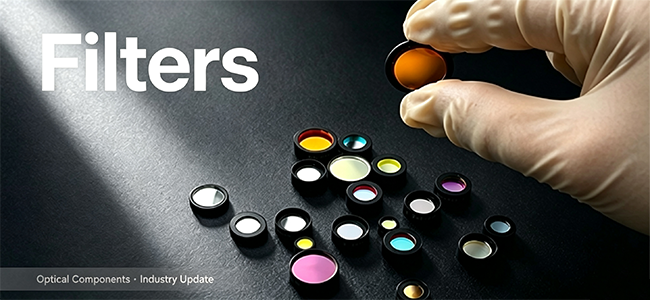
The real value of the OD4-to-OD6 leap on the "SNR gain" side depends heavily on the relationship between the incident excitation light intensity and the detector's intrinsic noise floor. When the system is already in a "detector-noise-limited" regime, the additional background suppression from OD6 translates into almost no SNR improvement. But when the system is in a "background-light-limited" regime, OD6 is the key to unlocking single-photon-level detection capability. On the "cost" side, this leap is nonlinear—layer count, stress control difficulty, yield, and coating time all worsen by several times or even exponentially.
The Essential Difference Between OD4 and OD6: More Than Just Numbers
The relationship between OD and transmittance T is OD = -log₁₀(T). Substituting the values:
OD4: T = 10⁻⁴ = 0.01%, attenuation ratio 10,000:1.
OD6: T = 10⁻⁶ = 0.0001%, attenuation ratio 1,000,000:1.
The absolute transmittance differs by a factor of 100. If 1 mW of stray light falls outside the passband of an OD4 filter, 100 nW still leaks through; with OD6, only 1 nW leaks through. In fluorescence microscopy imaging, this 99 nW difference is precisely the dividing line between a weak signal being drowned out and being clearly resolved.
SNR Gains: When They Matter, When They're Waste
The definition of SNR varies slightly across scenarios, but at its core it is the ratio of signal intensity to the noise floor. Raising the OD value essentially means suppressing the optical background component of the "noise floor." Its real benefit depends on the composition of the noise budget.
Scenario 1: Background-Light-Limited System—OD6's Gain Is a "Qualitative Leap"
In fluorescence detection, Raman spectroscopy, or chemiluminescence imaging, the excitation light is typically several orders of magnitude stronger than the emitted fluorescence. The filter's mission is to "let the excitation light die and let the fluorescence pass." If the excitation light leaking through an OD4 filter is still higher than the detector's noise equivalent power (NEP), or higher than the fluorescence signal itself, then the system is in a background-light-limited state. In this case, OD6's 100-fold background suppression translates directly into a significant SNR improvement.
This effect's boundary can be observed from experimental data: in ELISA-type assays, when the S/N ratio is below 3, the sample is judged negative; positive samples typically have S/N ratios between 4.3 and 7.5. If the system background is artificially elevated by filter leakage, a weak positive sample with an original S/N of 4 could be drowned out. OD6 suppresses the background by 100-fold, enough to lift the S/N from "indistinguishable" to "reliable positive."
A more extreme example comes from the field of visual diffuse transmission density measurement: when attempting to measure samples with OD values as high as 6.0, the signal intensity is only on the order of 10⁻⁶, and conventional detectors can no longer extract a signal from the noise. Researchers point out that at this point there are only two ways out: use a low-background-noise, high-sensitivity detector, or greatly increase the incident light flux. This confirms a key fact from the opposite direction: an OD6 filter itself does not create SNR—it merely clears the way for the detector to perform at its limit. If the detector's intrinsic noise floor is already higher than OD6's leakage level, then upgrading from OD4 to OD6 will produce no observable change in SNR.
Scenario 2: Detector-Noise-Limited System—OD6's Gain Approaches Zero
Modern scientific-grade CMOS and EMCCD read noise can be as low as sub-electron levels. In a system where the excitation light is well collimated and stray light is properly controlled, the optical power reaching the detector may be far above the detector's noise equivalent power, but the dominant noise source is detector dark current and read noise, not filter leakage. In this case, swapping OD4 for OD6 reduces leakage from 100 nW to 1 nW, but the detector's intrinsic noise equivalent optical power might be 10 nW—this 99 nW improvement is drowned in the detector's own sea of noise.
Empirical criterion: To judge whether OD4→OD6 delivers real benefit, simply calculate whether the filter's leakage power is comparable to or higher than the detector's noise equivalent power. If yes, OD6 is worth the investment; if the leakage power is already far below the NEP, upgrading the OD value is pure over-engineering.
Cost: From "Conventional Manufacturing" to "Extreme Challenge"
OD4 filters are a mature, mass-produced product in the optical coating industry. A few dozen layers, a few hours of coating time, acceptable yield—cost stays in the conventional range. OD6, by contrast, is known in the industry as "deep blocking" or the "Everest challenge."
According to industry manufacturing data, the cost leap from OD4 to OD6 manifests in the following dimensions:
The accumulation of coating stress is the most intractable physical limitation in OD6 manufacturing. Each coating layer introduces residual stress into the substrate. After more than a hundred layers are stacked, the stress may exceed the fracture threshold of the glass or the coating itself, causing substrate warping, film cracking, or delamination after coating is complete. This not only affects optical performance but directly destroys yield.
The decline in defect tolerance is equally fatal. A tiny pinhole or dust particle on an OD4 filter may have its leakage masked by the 10,000:1 attenuation ratio, with limited impact on system performance. But under OD6, the same defect's leakage path is effectively amplified 100-fold (relative to the target transmittance), and a single-point defect can degrade the entire filter's actual blocking capability to OD5 or even OD4 level.
Engineering Recommendations: When to Pay for OD6
1.Cases where upgrading to OD6 is warranted: In fluorescence detection, where excitation light intensity is 5–6 orders of magnitude higher than the fluorescence signal and the detector is photon-counting grade or EMCCD; in laser protection scenarios requiring absolute assurance of eye safety (OD6 attenuates 1,000,000-fold); in single-molecule-level spectral analysis, where background photon flux must be suppressed below the statistical fluctuation of single-photon events.
2.Cases where upgrading is unnecessary: When the main bottleneck in system SNR is detector read noise or sample autofluorescence; when excitation light is well collimated and spatial filtering has already sufficiently suppressed stray light; in cost-sensitive mass-production detection equipment, where OD4 is already sufficient to push the background below the S/N decision threshold.
3.Compromise solution: If the manufacturing cost of OD6 is hard to bear, consider an OD4 filter combined with an additional absorptive neutral density filter. Absorptive filters do not rely on interference coatings and can provide an additional 1–2 OD of attenuation in specific wavelength bands, at a cost far lower than an all-dielectric OD6 filter. The trade-off is increased insertion loss in the passband, and the OD value of absorptive filters is more sensitive to wavelength and angle.
Ultimately, the OD4-to-OD6 decision is a noise budget problem. First measure the composition of the system's noise floor, then decide whether to pay for that extra 100-fold background suppression.
The real value of the OD4-to-OD6 leap on the "SNR gain" side depends heavily on the relationship between the incident excitation light intensity and the detector's intrinsic noise floor. When the system is already in a "detector-noise-limited" regime, the additional background suppression from OD6 translates into almost no SNR improvement. But when the system is in a "background-light-limited" regime, OD6 is the key to unlocking single-photon-level detection capability. On the "cost" side, this leap is nonlinear—layer count, stress control difficulty, yield, and coating time all worsen by several times or even exponentially.
The Essential Difference Between OD4 and OD6: More Than Just Numbers
The relationship between OD and transmittance T is OD = -log₁₀(T). Substituting the values:
OD4: T = 10⁻⁴ = 0.01%, attenuation ratio 10,000:1.
OD6: T = 10⁻⁶ = 0.0001%, attenuation ratio 1,000,000:1.
The absolute transmittance differs by a factor of 100. If 1 mW of stray light falls outside the passband of an OD4 filter, 100 nW still leaks through; with OD6, only 1 nW leaks through. In fluorescence microscopy imaging, this 99 nW difference is precisely the dividing line between a weak signal being drowned out and being clearly resolved.
SNR Gains: When They Matter, When They're Waste
The definition of SNR varies slightly across scenarios, but at its core it is the ratio of signal intensity to the noise floor. Raising the OD value essentially means suppressing the optical background component of the "noise floor." Its real benefit depends on the composition of the noise budget.
Scenario 1: Background-Light-Limited System—OD6's Gain Is a "Qualitative Leap"
In fluorescence detection, Raman spectroscopy, or chemiluminescence imaging, the excitation light is typically several orders of magnitude stronger than the emitted fluorescence. The filter's mission is to "let the excitation light die and let the fluorescence pass." If the excitation light leaking through an OD4 filter is still higher than the detector's noise equivalent power (NEP), or higher than the fluorescence signal itself, then the system is in a background-light-limited state. In this case, OD6's 100-fold background suppression translates directly into a significant SNR improvement.
This effect's boundary can be observed from experimental data: in ELISA-type assays, when the S/N ratio is below 3, the sample is judged negative; positive samples typically have S/N ratios between 4.3 and 7.5. If the system background is artificially elevated by filter leakage, a weak positive sample with an original S/N of 4 could be drowned out. OD6 suppresses the background by 100-fold, enough to lift the S/N from "indistinguishable" to "reliable positive."
A more extreme example comes from the field of visual diffuse transmission density measurement: when attempting to measure samples with OD values as high as 6.0, the signal intensity is only on the order of 10⁻⁶, and conventional detectors can no longer extract a signal from the noise. Researchers point out that at this point there are only two ways out: use a low-background-noise, high-sensitivity detector, or greatly increase the incident light flux. This confirms a key fact from the opposite direction: an OD6 filter itself does not create SNR—it merely clears the way for the detector to perform at its limit. If the detector's intrinsic noise floor is already higher than OD6's leakage level, then upgrading from OD4 to OD6 will produce no observable change in SNR.
Scenario 2: Detector-Noise-Limited System—OD6's Gain Approaches Zero
Modern scientific-grade CMOS and EMCCD read noise can be as low as sub-electron levels. In a system where the excitation light is well collimated and stray light is properly controlled, the optical power reaching the detector may be far above the detector's noise equivalent power, but the dominant noise source is detector dark current and read noise, not filter leakage. In this case, swapping OD4 for OD6 reduces leakage from 100 nW to 1 nW, but the detector's intrinsic noise equivalent optical power might be 10 nW—this 99 nW improvement is drowned in the detector's own sea of noise.
Empirical criterion: To judge whether OD4→OD6 delivers real benefit, simply calculate whether the filter's leakage power is comparable to or higher than the detector's noise equivalent power. If yes, OD6 is worth the investment; if the leakage power is already far below the NEP, upgrading the OD value is pure over-engineering.
Cost: From "Conventional Manufacturing" to "Extreme Challenge"
OD4 filters are a mature, mass-produced product in the optical coating industry. A few dozen layers, a few hours of coating time, acceptable yield—cost stays in the conventional range. OD6, by contrast, is known in the industry as "deep blocking" or the "Everest challenge."
According to industry manufacturing data, the cost leap from OD4 to OD6 manifests in the following dimensions:
|
Dimension |
OD4 (relatively common) |
OD6 (deep blocking) |
|
Total coating thickness |
A few micrometers |
Tens of micrometers |
|
Number of layers |
A few dozen |
Around 100 or more |
|
Stress control |
Relatively easy to manage |
Key challenge, prone to cracking/delamination |
|
Defect tolerance |
Lower requirement |
Extremely high requirement |
|
Coating time |
A few hours |
A dozen hours or longer |
|
Yield |
Relatively high |
Significantly lower |
|
Cost |
Conventional |
Significantly higher |
The accumulation of coating stress is the most intractable physical limitation in OD6 manufacturing. Each coating layer introduces residual stress into the substrate. After more than a hundred layers are stacked, the stress may exceed the fracture threshold of the glass or the coating itself, causing substrate warping, film cracking, or delamination after coating is complete. This not only affects optical performance but directly destroys yield.
The decline in defect tolerance is equally fatal. A tiny pinhole or dust particle on an OD4 filter may have its leakage masked by the 10,000:1 attenuation ratio, with limited impact on system performance. But under OD6, the same defect's leakage path is effectively amplified 100-fold (relative to the target transmittance), and a single-point defect can degrade the entire filter's actual blocking capability to OD5 or even OD4 level.
Engineering Recommendations: When to Pay for OD6
1.Cases where upgrading to OD6 is warranted: In fluorescence detection, where excitation light intensity is 5–6 orders of magnitude higher than the fluorescence signal and the detector is photon-counting grade or EMCCD; in laser protection scenarios requiring absolute assurance of eye safety (OD6 attenuates 1,000,000-fold); in single-molecule-level spectral analysis, where background photon flux must be suppressed below the statistical fluctuation of single-photon events.
2.Cases where upgrading is unnecessary: When the main bottleneck in system SNR is detector read noise or sample autofluorescence; when excitation light is well collimated and spatial filtering has already sufficiently suppressed stray light; in cost-sensitive mass-production detection equipment, where OD4 is already sufficient to push the background below the S/N decision threshold.
3.Compromise solution: If the manufacturing cost of OD6 is hard to bear, consider an OD4 filter combined with an additional absorptive neutral density filter. Absorptive filters do not rely on interference coatings and can provide an additional 1–2 OD of attenuation in specific wavelength bands, at a cost far lower than an all-dielectric OD6 filter. The trade-off is increased insertion loss in the passband, and the OD value of absorptive filters is more sensitive to wavelength and angle.
Ultimately, the OD4-to-OD6 decision is a noise budget problem. First measure the composition of the system's noise floor, then decide whether to pay for that extra 100-fold background suppression.
Share this:


NEXT : Thermal Deformation and Surface Figure Retention of Metal Substrate Mirrors
TALK TO US 86-15584132290
Call us now!
86-15584132290Call us now!

ONLINE CHAT
 2433808388
2433808388