ISO9001 Certified Professional Manufacturer & Supplier of Optics
+86-0431-87911611 admin@ytoptics.com

Contact us
-
 Email: admin@ytoptics.com
-
 English Inquiry Support:
-
 Add: 2# Automotive InnovationPark,
City,Jilin Province, China
Thermal Deformation and Surface Figure Retention of Metal Substrate Mirrors
Satellites, laser communication terminals, and infrared telescopes all contain one or more mirrors. When these mirrors are made of metal instead of glass, they are lighter and conduct heat better—but there is a catch: metal expands and contracts with temperature. When the temperature changes, the mirror surface is no longer flat, and the optical system goes out of alignment.
What Happens When the Mirror Surface Is No Longer Flat
Once the mirror deforms, the wavefront is disturbed. In mild cases, the image plane blurs and the focal length drifts; in severe cases, imaging quality drops directly. For laser communication terminals, thermal deformation of the mirror causes beam divergence and wavefront distortion, reducing the power reaching the detector and making the communication link unstable. Therefore, controlling thermal deformation of metal mirrors is essentially about preserving optical performance.
Two Sources of Thermal Deformation
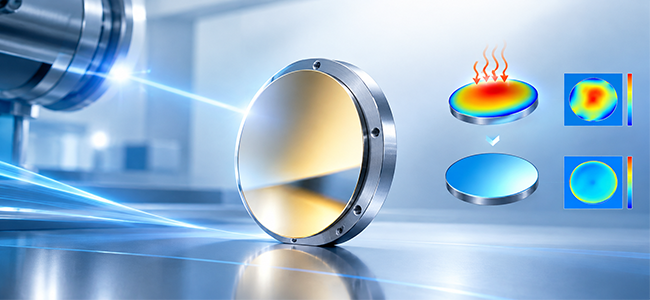
First, thermal expansion and contraction of the mirror body itself. When the temperature changes, every part of the mirror changes dimension. If one side of the mirror faces cold space while the other faces heat-generating electronics, the two sides have different temperatures and therefore different expansion amounts. Internal thermal stress builds up, twisting the mirror surface out of shape.
Second, the coating and the substrate "fight" each other. Aluminum mirrors are typically coated with a layer of chemical nickel, because nickel can be polished to optical-grade roughness. However, aluminum and nickel-phosphorus alloy have different coefficients of thermal expansion. When the temperature changes, one expands faster than the other, and the interface pulls against itself, bending the mirror. This is the bimetallic effect. In a low-temperature infrared system operating at 100 K, the temperature difference from room temperature to operating temperature can be several hundred degrees—enough to completely ruin the mirror surface through this bending.
How to Preserve the Surface Figure
Match the materials. Using high-silicon aluminum alloy (silicon content above 40%) as the substrate allows its coefficient of thermal expansion to be tuned close to that of the chemical nickel layer (about 13×10⁻⁶/K), fundamentally reducing bimetallic bending. Carbon fiber reinforced carbon and ceramic matrix composites offer another path, with extremely low thermal expansion coefficients and low density, making them suitable for high-temperature vacuum environments.
Release stress through structural design. Small- and medium-aperture metal mirrors (150–250 mm) now commonly use center back support or back mounting rather than outer flange mounting, specifically to reduce the effect of mounting stress on the mirror surface. Some studies use hybrid ball-joint secondary mirror assemblies to give thermal deformation room to release, keeping surface figure RMS around 3 nm over a range of -30°C to 70°C.
Compensate through design. A further approach: since thermal deformation cannot be avoided, design the mirror shape and material distribution in advance so that its deformation under a specific temperature field exactly "cancels out" the optical aberrations.
How to Verify
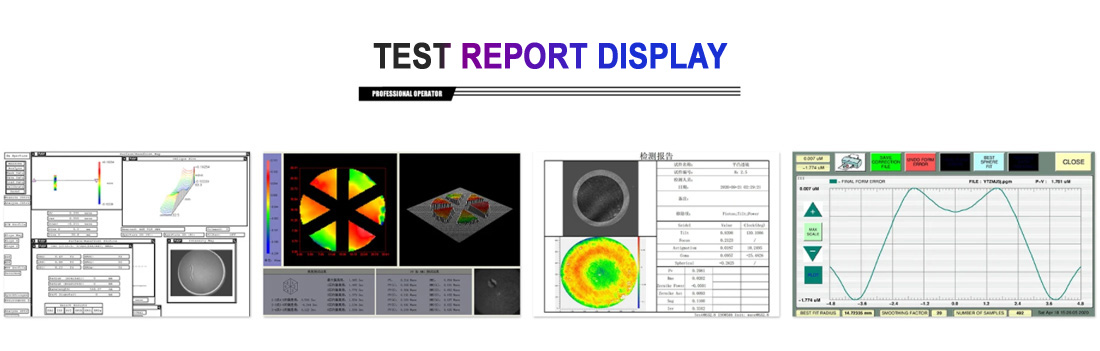
During the design stage, finite element analysis calculates surface figure changes under thermal loads, and Zernike polynomials decompose them into optical aberrations such as defocus and astigmatism to check whether they are within tolerance. Finally, an interferometer measures the mirror in a real temperature environment to confirm whether the simulation is reliable.
One point that is easily overlooked: the effect of fastening preload. In many cases, the force from tightening screws during assembly becomes the main source of surface figure error at low temperatures. Therefore, thermal design cannot focus only on materials and temperature—assembly processes also determine the final mirror surface quality.
Ultimately, controlling thermal deformation of metal mirrors is about finding a balance between material thermal expansion and contraction, structural stiffness, and optical surface figure tolerance. The combination of expansion-matched materials, flexible assembly, and active compensation is pushing metal mirrors toward more extreme temperature environments. In the manufacturing and surface figure control of such high-precision metal mirrors, Changchun Yutai Optics has long specialized in the processing and thermal stability optimization of metal substrate mirrors—from material selection and coating matching to assembly processes—providing practical surface figure retention solutions for space optics and low-temperature infrared systems.
What Happens When the Mirror Surface Is No Longer Flat
Once the mirror deforms, the wavefront is disturbed. In mild cases, the image plane blurs and the focal length drifts; in severe cases, imaging quality drops directly. For laser communication terminals, thermal deformation of the mirror causes beam divergence and wavefront distortion, reducing the power reaching the detector and making the communication link unstable. Therefore, controlling thermal deformation of metal mirrors is essentially about preserving optical performance.
Two Sources of Thermal Deformation
First, thermal expansion and contraction of the mirror body itself. When the temperature changes, every part of the mirror changes dimension. If one side of the mirror faces cold space while the other faces heat-generating electronics, the two sides have different temperatures and therefore different expansion amounts. Internal thermal stress builds up, twisting the mirror surface out of shape.
Second, the coating and the substrate "fight" each other. Aluminum mirrors are typically coated with a layer of chemical nickel, because nickel can be polished to optical-grade roughness. However, aluminum and nickel-phosphorus alloy have different coefficients of thermal expansion. When the temperature changes, one expands faster than the other, and the interface pulls against itself, bending the mirror. This is the bimetallic effect. In a low-temperature infrared system operating at 100 K, the temperature difference from room temperature to operating temperature can be several hundred degrees—enough to completely ruin the mirror surface through this bending.
How to Preserve the Surface Figure
Match the materials. Using high-silicon aluminum alloy (silicon content above 40%) as the substrate allows its coefficient of thermal expansion to be tuned close to that of the chemical nickel layer (about 13×10⁻⁶/K), fundamentally reducing bimetallic bending. Carbon fiber reinforced carbon and ceramic matrix composites offer another path, with extremely low thermal expansion coefficients and low density, making them suitable for high-temperature vacuum environments.
Release stress through structural design. Small- and medium-aperture metal mirrors (150–250 mm) now commonly use center back support or back mounting rather than outer flange mounting, specifically to reduce the effect of mounting stress on the mirror surface. Some studies use hybrid ball-joint secondary mirror assemblies to give thermal deformation room to release, keeping surface figure RMS around 3 nm over a range of -30°C to 70°C.
Compensate through design. A further approach: since thermal deformation cannot be avoided, design the mirror shape and material distribution in advance so that its deformation under a specific temperature field exactly "cancels out" the optical aberrations.
How to Verify
During the design stage, finite element analysis calculates surface figure changes under thermal loads, and Zernike polynomials decompose them into optical aberrations such as defocus and astigmatism to check whether they are within tolerance. Finally, an interferometer measures the mirror in a real temperature environment to confirm whether the simulation is reliable.
One point that is easily overlooked: the effect of fastening preload. In many cases, the force from tightening screws during assembly becomes the main source of surface figure error at low temperatures. Therefore, thermal design cannot focus only on materials and temperature—assembly processes also determine the final mirror surface quality.
Ultimately, controlling thermal deformation of metal mirrors is about finding a balance between material thermal expansion and contraction, structural stiffness, and optical surface figure tolerance. The combination of expansion-matched materials, flexible assembly, and active compensation is pushing metal mirrors toward more extreme temperature environments. In the manufacturing and surface figure control of such high-precision metal mirrors, Changchun Yutai Optics has long specialized in the processing and thermal stability optimization of metal substrate mirrors—from material selection and coating matching to assembly processes—providing practical surface figure retention solutions for space optics and low-temperature infrared systems.
Share this:


NEXT : Deformation Control of Large-Aperture Optical Windows in Vacuum/High-Pressure Environments
TALK TO US 86-15584132290
Call us now!
86-15584132290Call us now!

ONLINE CHAT
 2433808388
2433808388