ISO9001 Certified Professional Manufacturer & Supplier of Optics
+86-0431-87911611 admin@ytoptics.com

Contact us
-
 Email: admin@ytoptics.com
-
 English Inquiry Support:
-
 Add: 2# Automotive InnovationPark,
City,Jilin Province, China
Optical Components: The First Perceptual Threshold of Embodied Intelligence
Optical components are the first threshold of embodied intelligence perception systems, and they are currently one of the most easily underestimated links in the supply chain. They do not emit light, compute, or store data, yet they determine whether a robot can see clearly, accurately, and far. Validation in industrial scenarios has already been completed, but the mass production demands of humanoid robots are pushing optical components toward an unprecedented stress test.
The perception system of embodied intelligence can be broken down into four layers: optical components, image sensors, depth computing chips, and algorithms. Algorithms determine what a robot "understands," chips determine how fast it "computes," and sensors determine how much light it "receives"—while optical components determine whether the light it "receives" is correct.
This order is important. Optical components are the entry point of the entire chain. Once the entry point is distorted, all subsequent links are paying for erroneous data.
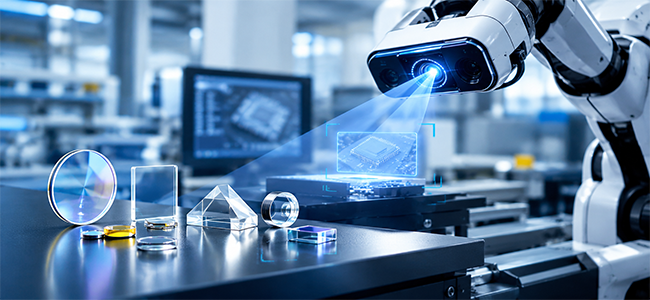
Specifically, optical components undertake three types of tasks in embodied intelligence:
First, imaging. For a robot to recognize objects, judge distances, and reconstruct environments, the premise is that light, after passing through optical lenses and windows, falls onto the image sensor as faithfully as possible. For every 1% increase in transmittance, the signal-to-noise ratio in low-light environments improves by one level. Robots must work under complex lighting conditions such as warehouses, corridors, and outdoors, and this 1% is often the dividing line between "visible" and "invisible."
Second, ranging. 3D structured light and ToF solutions rely on optical windows and narrowband filters to precisely project light of specific wavelengths and precisely receive it back. The narrower the filter's bandwidth, the stronger its ability to resist ambient light interference, and the higher the ranging accuracy. But for every nanometer the bandwidth is narrowed, the number of coating layers must increase, and yield must decrease. This is a continuous tug-of-war between precision and cost.
Third, environmental adaptation. Robots are not laboratory equipment. They must work continuously in high temperatures, high humidity, vibration, and dust. Optical components must maintain unchanged spectral characteristics under temperature variations of ±40°C, which places extremely high demands on the matching of thermal expansion coefficients of coating materials. A window that is perfect at room temperature may "go blind" in a cold storage at minus ten degrees or a workshop at forty degrees.
Why is this link the most easily underestimated in embodied intelligence perception systems?
Because optical components "look too simple."
They do not have process nodes to label like chips, parameters to show off like algorithms, or energy density to compare like batteries. They are just a piece of glass, a layer of coating, a prism. But it is precisely this "simplicity" that conceals the threefold barriers behind them: coating processes, inspection equipment, and material purity.
A narrowband filter used for robot vision can have dozens of coating layers, with wavelength deviation controlled within ±2 nanometers and surface roughness required at the sub-nanometer level. This is not a problem of a single piece of glass; it is a problem of the superposition of threefold barriers: coating processes, inspection equipment, and material purity. And none of these three barriers can be crossed by simply purchasing equipment.
More critically, the performance ceiling of optical components directly determines the performance ceiling of the perception system. Algorithms can iterate, chips can upgrade, but if the first gateway through which light enters the system is not good enough, all subsequent links are doing compensation rather than optimization.
Humanoid robots are pushing optical components to their limits
The requirements that industrial robots place on optical components are "reliability"; the requirements that humanoid robots place on optical components are "reliability + lightweight + low cost."
A single humanoid robot requires at least 3 vision sensors (head, torso, and hands). If global shipments reach 62,500 units in 2026, depth cameras alone will require nearly 190,000 modules. If shipments reach the million-unit level by 2030, annual demand for vision sensors will approach the ten-million level.
For the optical components industry, this scale is unfamiliar. In the past, customers for high-end optical components were the military, scientific research, and industrial inspection, with small order volumes, high unit prices, and long delivery cycles. Humanoid robots demand the rhythm of consumer electronics: monthly production capacity in the millions, unit prices squeezed to just a few dollars, and delivery cycles measured in weeks.
This is not a problem that can be solved by simply "expanding production." It requires optical component companies to fully work through the scaling of coating processes, the automation of inspection links, and the domestic substitution of materials, all while maintaining sub-nanometer precision. Each path takes time, and the mass production timetable for humanoid robots will not wait.
At the same time, the split in technological routes makes the supply chain even more difficult. Some manufacturers insist on a pure vision solution, while others adopt a "depth camera + LiDAR" fusion solution. The two routes have completely different requirements for optical components: the pure vision solution requires imaging lenses with high transmittance and low distortion; the fusion solution also requires narrowband filters, optical windows, prisms, and other active-passive hybrid components. The supply chain must support both paths simultaneously, and no one dares to bet on a single direction, and no one dares to expand production at full force.
The good news is that optical components have already completed a round of domestic substitution validation in the industrial robot field. In the 2025 guided industrial 3D camera market, the share of domestic brands exceeded 85%. The shipment volume, reliability, and cost control capabilities of industrial scenarios have all been tested in practice.
This means that the foundational capabilities of optical components are already there. The challenge of humanoid robots is not starting from zero, but achieving both industrial-grade reliability and consumer-grade cost at the same time. Industrial cameras can sell for several thousand yuan, while vision modules on humanoid robots must be reduced to several hundred yuan or even lower, while still meeting millimeter-level precision and adaptability to complex lighting.
The cost-reduction path for optical components is clear: the scaling of coating processes, the automation of inspection links, and the domestic substitution of materials. In 2026, some domestic companies achieved key breakthroughs in the fields of optical windows and filters, building an independent supply chain closed loop from materials to coating. This means that domestic vision sensors finally have an independent option at the most upstream optical component link.
A robot can do without the strongest algorithm, but it cannot do without the most accurate "eyes." If the algorithm is a little worse, the robot moves a little more slowly and clumsily; if the optical components are a little worse, the robot may directly hit a wall, grasp at nothing, or fall. The fault tolerance of the perception system is far lower than that of the computing system.
This is also why optical components deserve to be discussed separately. They are not the most dazzling link in the embodied intelligence industry chain, but they are the link where mistakes are least tolerable. In industrial scenarios, this conclusion has already been verified. In humanoid robot scenarios, this conclusion is now being verified.
The perception system of embodied intelligence can be broken down into four layers: optical components, image sensors, depth computing chips, and algorithms. Algorithms determine what a robot "understands," chips determine how fast it "computes," and sensors determine how much light it "receives"—while optical components determine whether the light it "receives" is correct.
This order is important. Optical components are the entry point of the entire chain. Once the entry point is distorted, all subsequent links are paying for erroneous data.
Specifically, optical components undertake three types of tasks in embodied intelligence:
First, imaging. For a robot to recognize objects, judge distances, and reconstruct environments, the premise is that light, after passing through optical lenses and windows, falls onto the image sensor as faithfully as possible. For every 1% increase in transmittance, the signal-to-noise ratio in low-light environments improves by one level. Robots must work under complex lighting conditions such as warehouses, corridors, and outdoors, and this 1% is often the dividing line between "visible" and "invisible."
Second, ranging. 3D structured light and ToF solutions rely on optical windows and narrowband filters to precisely project light of specific wavelengths and precisely receive it back. The narrower the filter's bandwidth, the stronger its ability to resist ambient light interference, and the higher the ranging accuracy. But for every nanometer the bandwidth is narrowed, the number of coating layers must increase, and yield must decrease. This is a continuous tug-of-war between precision and cost.
Third, environmental adaptation. Robots are not laboratory equipment. They must work continuously in high temperatures, high humidity, vibration, and dust. Optical components must maintain unchanged spectral characteristics under temperature variations of ±40°C, which places extremely high demands on the matching of thermal expansion coefficients of coating materials. A window that is perfect at room temperature may "go blind" in a cold storage at minus ten degrees or a workshop at forty degrees.
Why is this link the most easily underestimated in embodied intelligence perception systems?
Because optical components "look too simple."
They do not have process nodes to label like chips, parameters to show off like algorithms, or energy density to compare like batteries. They are just a piece of glass, a layer of coating, a prism. But it is precisely this "simplicity" that conceals the threefold barriers behind them: coating processes, inspection equipment, and material purity.
A narrowband filter used for robot vision can have dozens of coating layers, with wavelength deviation controlled within ±2 nanometers and surface roughness required at the sub-nanometer level. This is not a problem of a single piece of glass; it is a problem of the superposition of threefold barriers: coating processes, inspection equipment, and material purity. And none of these three barriers can be crossed by simply purchasing equipment.
More critically, the performance ceiling of optical components directly determines the performance ceiling of the perception system. Algorithms can iterate, chips can upgrade, but if the first gateway through which light enters the system is not good enough, all subsequent links are doing compensation rather than optimization.
Humanoid robots are pushing optical components to their limits
The requirements that industrial robots place on optical components are "reliability"; the requirements that humanoid robots place on optical components are "reliability + lightweight + low cost."
A single humanoid robot requires at least 3 vision sensors (head, torso, and hands). If global shipments reach 62,500 units in 2026, depth cameras alone will require nearly 190,000 modules. If shipments reach the million-unit level by 2030, annual demand for vision sensors will approach the ten-million level.
For the optical components industry, this scale is unfamiliar. In the past, customers for high-end optical components were the military, scientific research, and industrial inspection, with small order volumes, high unit prices, and long delivery cycles. Humanoid robots demand the rhythm of consumer electronics: monthly production capacity in the millions, unit prices squeezed to just a few dollars, and delivery cycles measured in weeks.
This is not a problem that can be solved by simply "expanding production." It requires optical component companies to fully work through the scaling of coating processes, the automation of inspection links, and the domestic substitution of materials, all while maintaining sub-nanometer precision. Each path takes time, and the mass production timetable for humanoid robots will not wait.
At the same time, the split in technological routes makes the supply chain even more difficult. Some manufacturers insist on a pure vision solution, while others adopt a "depth camera + LiDAR" fusion solution. The two routes have completely different requirements for optical components: the pure vision solution requires imaging lenses with high transmittance and low distortion; the fusion solution also requires narrowband filters, optical windows, prisms, and other active-passive hybrid components. The supply chain must support both paths simultaneously, and no one dares to bet on a single direction, and no one dares to expand production at full force.
The good news is that optical components have already completed a round of domestic substitution validation in the industrial robot field. In the 2025 guided industrial 3D camera market, the share of domestic brands exceeded 85%. The shipment volume, reliability, and cost control capabilities of industrial scenarios have all been tested in practice.
This means that the foundational capabilities of optical components are already there. The challenge of humanoid robots is not starting from zero, but achieving both industrial-grade reliability and consumer-grade cost at the same time. Industrial cameras can sell for several thousand yuan, while vision modules on humanoid robots must be reduced to several hundred yuan or even lower, while still meeting millimeter-level precision and adaptability to complex lighting.
The cost-reduction path for optical components is clear: the scaling of coating processes, the automation of inspection links, and the domestic substitution of materials. In 2026, some domestic companies achieved key breakthroughs in the fields of optical windows and filters, building an independent supply chain closed loop from materials to coating. This means that domestic vision sensors finally have an independent option at the most upstream optical component link.
A robot can do without the strongest algorithm, but it cannot do without the most accurate "eyes." If the algorithm is a little worse, the robot moves a little more slowly and clumsily; if the optical components are a little worse, the robot may directly hit a wall, grasp at nothing, or fall. The fault tolerance of the perception system is far lower than that of the computing system.
This is also why optical components deserve to be discussed separately. They are not the most dazzling link in the embodied intelligence industry chain, but they are the link where mistakes are least tolerable. In industrial scenarios, this conclusion has already been verified. In humanoid robot scenarios, this conclusion is now being verified.
Share this:


NEXT : Why Do S-Polarized and P-Polarized Light Have Different Reflectivity at 45°?
TALK TO US 86-15584132290
Call us now!
86-15584132290Call us now!

ONLINE CHAT
 2433808388
2433808388