ISO9001 Certified Professional Manufacturer & Supplier of Optics
+86-0431-87911611 admin@ytoptics.com

Contact us
-
 Email: admin@ytoptics.com
-
 English Inquiry Support:
-
 Add: 2# Automotive InnovationPark,
City,Jilin Province, China
Who Is Purchasing Optical Rods Lenses? — Selection Criteria and Procurement Drivers in Four Key Sect
Among optical components, rod lenses are a unique category characterized by their “minimalist” design and “precise” functionality. Shaped like a slender cylinder, their circumferential surface is precision-polished to refract light, while both end faces are typically ground. This structure allows them to interact with light beams in only one dimension, and it is precisely this characteristic that gives rod lenses an irreplaceable role in numerous high-tech fields. So, exactly which professionals in which fields choose to purchase optical rod lenses? And what is their decision-making logic?
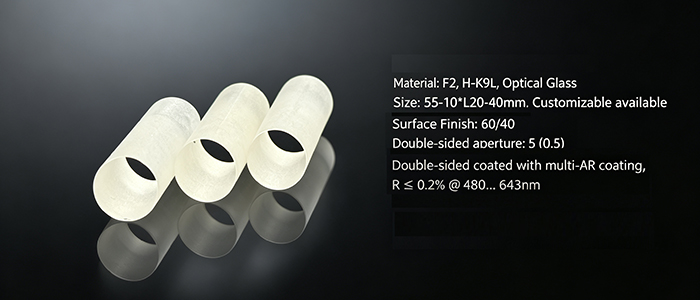
Lasers and Optoelectronics: The “Standard Configuration” for Semiconductor Lasers
This is the field where rod lenses are most widely used and where technical requirements are the highest. Purchasers are typically laser R&D engineers and optical system integrators, and their core requirement is fast-axis collimation (FAC).
The emitted beam from a semiconductor laser (laser bar) has an extremely large divergence angle along the fast axis and must be collimated to be practical. Small-diameter rod lenses, with their high numerical aperture and short focal length, are the ideal choice for this task. The reason for this selection is that the focal length of a rod lens is uniquely determined by its diameter and the refractive index of the material (f = nD/[4(n-1)]), meaning that selecting a diameter locks in the focal length, thereby simplifying optical path design. For high-power applications, buyers specify infrared materials such as silicon and sapphire—which offer excellent thermal conductivity and high-temperature resistance—and prioritize anti-reflective coatings to minimize losses. Precision requirements are extremely stringent, with diameter tolerances controlled to ±0.0075 mm and eccentricity better than 3 arcminutes.
Medical and Life Sciences: The “Precision Eye” of Endoscopes and Flow Cytometers
In the medical field, purchasers are medical device R&D engineers, and applications are concentrated in rigid endoscopes and flow cytometers.
In rigid endoscopes, rod lenses serve as relay lenses, performing the function of image transmission. Their slender structure naturally complements the shape of the endoscope body. They are selected because connecting multiple rod lenses in series enables forward image transmission while simplifying mechanical support. In flow cytometers, rod lenses are used to focus a laser into a line spot to excite fluorescently labeled cells. Purchasers in this field place a high priority on imaging clarity and ease of system integration, requiring materials to have high transmittance in the visible light spectrum (e.g., H-K9L) and reliable surface quality (e.g., 60/40 S/D).
Industrial Manufacturing and Inspection: The “Beam Shaper” for Barcode Scanning and Laser Processing
Purchasers in the industrial sector include automation engineers, production line maintenance personnel, and R&D staff; their primary motivation for purchasing is to “stretch the beam into a line.”
In barcode scanners, rod lenses shape a point source or collimated beam into a narrow, elongated spot that is projected onto the barcode for the sensor to read. In laser processing applications such as laser line marking and material surface treatment, a linear beam spot can significantly improve processing efficiency. The reason buyers choose rod lenses is straightforward: they offer the simplest structure and lowest cost for achieving a linear beam spot. Most standard products (such as those made of H-K9L material) are sufficient, requiring only verification that the length covers the scanning area.
Optical Communications and Research: “Performance Seekers” for Fiber Coupling and Specialized Experiments
Purchasers in the optical communications field are often optical module design engineers who use rod lenses for fiber coupling and beam alignment. Rod lenses are compact, making them suitable for compact module designs. When purchasing, they place great emphasis on the quality of the anti-reflection coatings on the end faces to suppress return loss and seek extremely stable, low insertion loss performance.
Research users, on the other hand, are more flexible. They may purchase rod lenses for beam homogenization, projection systems, or the validation of novel optical paths, and their focus is often on customization capabilities—such as the ability to process special materials like sapphire or implement unconventional polishing schemes .
Yutai Optics can provide custom dimensions, various polished/ground surfaces, and coatings upon request.
This is the field where rod lenses are most widely used and where technical requirements are the highest. Purchasers are typically laser R&D engineers and optical system integrators, and their core requirement is fast-axis collimation (FAC).
The emitted beam from a semiconductor laser (laser bar) has an extremely large divergence angle along the fast axis and must be collimated to be practical. Small-diameter rod lenses, with their high numerical aperture and short focal length, are the ideal choice for this task. The reason for this selection is that the focal length of a rod lens is uniquely determined by its diameter and the refractive index of the material (f = nD/[4(n-1)]), meaning that selecting a diameter locks in the focal length, thereby simplifying optical path design. For high-power applications, buyers specify infrared materials such as silicon and sapphire—which offer excellent thermal conductivity and high-temperature resistance—and prioritize anti-reflective coatings to minimize losses. Precision requirements are extremely stringent, with diameter tolerances controlled to ±0.0075 mm and eccentricity better than 3 arcminutes.
Medical and Life Sciences: The “Precision Eye” of Endoscopes and Flow Cytometers
In the medical field, purchasers are medical device R&D engineers, and applications are concentrated in rigid endoscopes and flow cytometers.
In rigid endoscopes, rod lenses serve as relay lenses, performing the function of image transmission. Their slender structure naturally complements the shape of the endoscope body. They are selected because connecting multiple rod lenses in series enables forward image transmission while simplifying mechanical support. In flow cytometers, rod lenses are used to focus a laser into a line spot to excite fluorescently labeled cells. Purchasers in this field place a high priority on imaging clarity and ease of system integration, requiring materials to have high transmittance in the visible light spectrum (e.g., H-K9L) and reliable surface quality (e.g., 60/40 S/D).
Industrial Manufacturing and Inspection: The “Beam Shaper” for Barcode Scanning and Laser Processing
Purchasers in the industrial sector include automation engineers, production line maintenance personnel, and R&D staff; their primary motivation for purchasing is to “stretch the beam into a line.”
In barcode scanners, rod lenses shape a point source or collimated beam into a narrow, elongated spot that is projected onto the barcode for the sensor to read. In laser processing applications such as laser line marking and material surface treatment, a linear beam spot can significantly improve processing efficiency. The reason buyers choose rod lenses is straightforward: they offer the simplest structure and lowest cost for achieving a linear beam spot. Most standard products (such as those made of H-K9L material) are sufficient, requiring only verification that the length covers the scanning area.
Optical Communications and Research: “Performance Seekers” for Fiber Coupling and Specialized Experiments
Purchasers in the optical communications field are often optical module design engineers who use rod lenses for fiber coupling and beam alignment. Rod lenses are compact, making them suitable for compact module designs. When purchasing, they place great emphasis on the quality of the anti-reflection coatings on the end faces to suppress return loss and seek extremely stable, low insertion loss performance.
Research users, on the other hand, are more flexible. They may purchase rod lenses for beam homogenization, projection systems, or the validation of novel optical paths, and their focus is often on customization capabilities—such as the ability to process special materials like sapphire or implement unconventional polishing schemes .
Yutai Optics can provide custom dimensions, various polished/ground surfaces, and coatings upon request.
Share this:


PREV : A Comprehensive Guide to Selecting Optical Coatings: Characteristics and Applications of Six Common NEXT : Improvement of Silicon Lens Transmittance by Anti-Reflective Coating
TALK TO US 86-15584132290
Call us now!
86-15584132290Call us now!

ONLINE CHAT
 2433808388
2433808388