
-
 Email: admin@ytoptics.com
-
 English Inquiry Support:
-
 Add: 2# Automotive InnovationPark,
City,Jilin Province, China
A Comprehensive Guide to Selecting Optical Coatings: Characteristics and Applications of Six Common
This article analyses the issue from two perspectives: functional principles and application scenarios.
I. Anti-Reflection Coatings: AR and BBAR Coatings
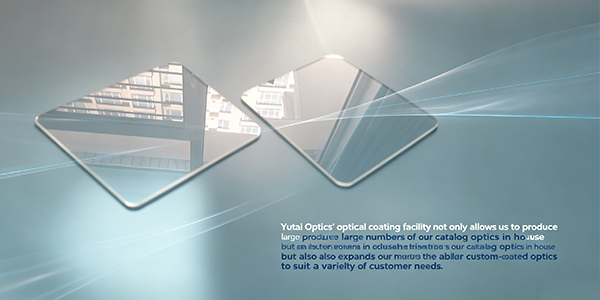
AR coatings are the most widely used type of coating in all optical systems. Their principle of operation is based on the interference of light—a thin film of a specific thickness is deposited onto the surface of an optical element, causing the light reflected from the front and rear surfaces to interfere constructively, thereby reducing reflection loss and increasing transmittance. With a single-sided AR coating, transmittance can reach T > 95 per cent, whilst a double-sided coating can achieve T > 98 per cent.
AR coatings are suitable for almost all applications where light needs to ‘pass through’: camera lenses, microscope objectives, display protectors, spectacle lenses, and instrument viewing windows, amongst others. Their core value lies in enhancing image brightness and clarity, whilst eliminating glare.
BBAR coatings are the ‘advanced version’ of AR coatings. Comprising alternating layers of high- and low-refractive-index materials, they can maintain reflectance at extremely low levels across the entire visible light spectrum (400–700 nm) and even broader spectral ranges. BBAR coatings are suitable for wide-spectrum applications, such as photographic lenses, visual optical systems and multi-wavelength laser systems. If a system operates at a single laser wavelength, a V-type coating optimised for that wavelength offers better value for money; if the system requires coverage across a broad spectral range, a BBAR coating is the obvious choice.
II. Protective Coatings: DLC Coatings and AF/AS Coatings
DLC coatings are a class of amorphous carbon thin films characterised by extremely high hardness, excellent wear resistance, corrosion resistance and chemical stability. In the field of optics, DLC coatings can serve as constituent materials for high-reflection filters, or be used as anti-reflection coatings in applications such as silicon solar cells.
The key criterion for selecting a DLC coating is whether the application faces harsh environmental conditions. If an optical window needs to operate long-term in environments subject to dust, humidity, chemical corrosion or mechanical friction, a DLC coating is an essential protective layer. It is commonly used in military optical windows, industrial inspection windows and infrared optical systems.
AF/AS coatings (anti-fingerprint/anti-soiling coatings) involve depositing fluorinated organic materials onto the substrate surface via vacuum coating technology, forming a thin film with extremely low surface energy. This endows the substrate with water-repellent, oil-repellent, anti-fingerprint, anti-soiling and easy-to-clean properties. The principle is based on the ‘lotus effect’—reducing surface tension to prevent dust and grease from adhering.
The core applications of AF coatings are touchscreens and human-machine interfaces: mobile phone screens, tablets, smart home touch panels, in-car central control screens, and so on. They directly determine the user’s tactile experience and the cleanliness of the screen.
III. Functional Categories: Hydrophobic Coatings and ITO/FTO Coatings
Hydrophobic coatings and AF coatings overlap in terms of function—both achieve water-repellent effects by reducing surface energy. The distinction lies in the fact that hydrophobic coatings typically focus more on ‘water repellency’ per se, whilst AF coatings offer a combination of hydrophobic, oleophobic and anti-fingerprint properties. When selecting a coating, if only basic moisture and fog resistance is required (such as for car rear-view mirrors or outdoor optical windows), a hydrophobic coating will suffice; however, if anti-fingerprint and easy-to-clean properties are also required, an AF coating is more suitable.
ITO/FTO coatings differ fundamentally from the previous five categories—their core function is not optical control, but rather electrical conductivity. Both ITO and FTO are transparent conductive oxide films that combine high visible light transmittance with good electrical conductivity. ITO can achieve a resistivity as low as 3×10⁻⁴ Ω·cm, whilst FTO offers superior high-temperature stability.
Key applications for these two types of coatings include: transparent electrodes for flat-panel displays, touch panels, solar cell electrodes, anti-fog and defrosting heated windows, and gas sensors. The key considerations when selecting a coating are as follows: choose ITO for superior conductivity (though indium is a scarce resource and costs are high); choose FTO for high-temperature stability and cost-effectiveness (commonly used in photovoltaic devices).
IV. Combined Solutions: 1+1>2
In practical engineering applications, multiple coatings are often combined to achieve optimal overall performance. For example:
AR + AF/AS: Achieving both high light transmittance and anti-fingerprint properties on display windows
AR + DLC: Providing wear-resistant protection for high-transmittance windows
ITO/FTO + AR: Overlaying an anti-reflective coating onto a transparent conductive film to balance conductivity and light transmittance
Selection Decision-Making Framework
When considering the six types of coatings, decisions should be made according to the following approach:
Primary objective: Should light be ‘transmitted’ or ‘reflected’? → AR/BBAR; Should the component be ‘conductive’ or ‘protective’? → ITO/FTO or DLC/AF
Spectral requirements: Single wavelength → Single-layer AR or V-type coating; Broad spectrum → BBAR
Environmental factors: Outdoor/abrasive environments → DLC hydrophobic coating; Touch operation → AF/AS
Functional integration: Is a composite coating required to meet multiple requirements?
By clarifying the above four points, you can make a precise selection from the six types of coatings.


PREV : Core Applications of BK7 Optical Glass Lenses in Machine Vision and Laboratory Systems NEXT : Who Is Purchasing Optical Rods Lenses? — Selection Criteria and Procurement Drivers in Four Key Sect
 86-15584132290
Call us now!

 2433808388