ISO9001 Certified Professional Manufacturer & Supplier of Optics
+86-0431-87911611 admin@ytoptics.com

Contact us
-
 Email: admin@ytoptics.com
-
 English Inquiry Support:
-
 Add: 2# Automotive InnovationPark,
City,Jilin Province, China
UV-Transmitting Visible-Absorbing Glass: Principles and Applications of the ZWB Series Filters
In the field of UV optics, precision coating is not the only technical route for filters. When an application is more cost-sensitive and does not require an extremely steep cutoff edge, UV-transmitting visible-absorbing glass is often a more practical choice. The ZWB series produced by Yutai Optics is a representative of this classic type of optical material.
What Is the ZWB Series Absorbing-Type UV Filter?
Visually, ZWB series glass appears deep black or dark reddish-black and is almost opaque. This "blackness" is not a defect but the core of its function—it needs to absorb all visible light and allow only ultraviolet light to pass through.
Unlike interference-coated filters, which rely on the interference effect of multiple thin films on the surface to achieve wavelength selection, the ZWB series works by bulk absorption: specific metal oxides are doped into the glass during melting, causing the glass material itself to produce strong intrinsic absorption in the visible band while maintaining relatively high transmittance in the near-ultraviolet band. This "material-level" filtering mechanism determines that it is fundamentally different from coated products in terms of cost, durability, and spectral characteristics.
Depending on the grade, the main differences among ZWB1, ZWB2, and ZWB3 lie in glass thickness and minor formulation adjustments. The figure below shows the spectral transmittance curves and key technical parameters of the three grades—ZWB1 and ZWB2 have a thickness of 1 mm, while ZWB3 has a thickness of 2 mm. The three differ in their transmittance specifications at characteristic wavelengths such as 254 nm, 280 nm, 313 nm, 334 nm, 365 nm, and 405 nm, and can be selected according to the specific application band.
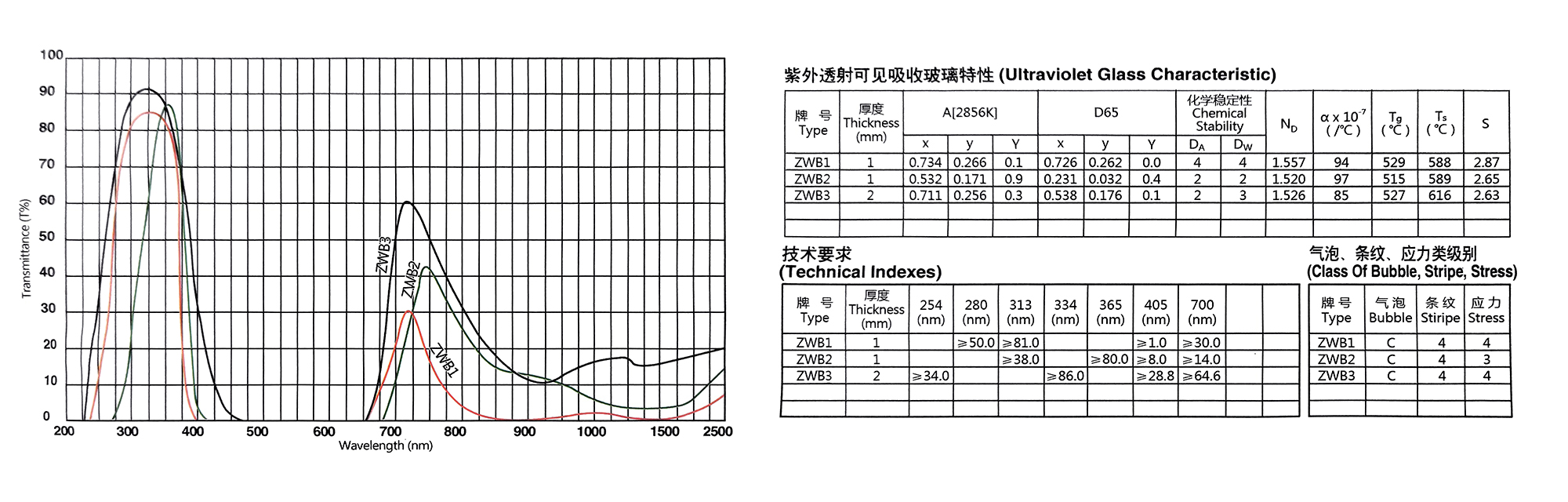 As can be seen from the curves, the transmittance of ZWB1 and ZWB2 near 365 nm both exceed 80%, while ZWB3 still has a transmittance of more than 34% at 254 nm, making it suitable for shorter-wavelength UV applications. All three products exhibit deep cutoff in the visible range from 400 nm to 700 nm, effectively suppressing interference from visible background light in UV detection.
Why Choose Absorbing-Type Glass?
Significant cost advantage. Coated UV filters require precise deposition of dozens or even hundreds of thin films, involving a complex process and difficult yield control. In contrast, the core of absorbing-type glass manufacturing lies in glass melting and forming, eliminating the expensive coating step and greatly reducing unit cost.
Stable spectral characteristics. The spectral performance of coated filters depends on precise control of film thickness and interfaces, and temperature changes or long-term use may cause drift in the central wavelength. The spectral characteristics of absorbing-type glass are determined by the intrinsic absorption of the material, making it much less sensitive to the environment and more stable under normal operating conditions.
Guaranteed cutoff depth. For the core requirement of "filtering out visible light," absorbing-type glass performs quite well in the visible band and can effectively suppress interference from stray light in UV detection. This makes it fully capable in scenarios where the steepness of the cutoff edge is not critical.
Typical Application Scenarios
The most common application scenarios for ZWB series absorbing-type UV filters include:
UV analytical instruments. In equipment such as fluorescence detection systems and UV spectrophotometers, it is necessary to extract the UV component from a broadband light source. ZWB series glass can effectively filter out visible background light and improve the signal-to-noise ratio of detection.
Banknote verification and anti-counterfeiting detection. In 365 nm UV banknote verification lamps, ZWB series filters are used to remove visible light, making the excitation effect of fluorescent anti-counterfeiting marks clearer. This is one of the most mature mass applications of this material.
UV curing and sterilization equipment. In UV curing lamps or sterilization lamps where the spectral range needs to be controlled, absorbing-type glass can provide preliminary wavelength screening.
Scientific research and industrial inspection. For laboratory scenarios with limited budgets but a need for reliable UV filtering, the ZWB series offers a highly cost-effective solution.
Positioning Difference from Coated UV Filters
It should be clearly understood that absorbing-type glass and coated filters are not substitutes for each other, but rather two technical routes serving different levels of demand.
The advantages of coated interference filters lie in high transmittance, deep cutoff, and extremely steep edge transition, enabling precise control of bandwidth, which makes them suitable for precision fields such as lasers, semiconductor lithography, and high-end spectrometers. The positioning of ZWB series absorbing-type glass, by contrast, is economical, practical, stable in performance, and sufficient for basic filtering needs.
For applications that only require "transmitting UV and blocking visible light," choosing the ZWB series is often more reasonable than customizing coated filters. This is also why Yutai Optics offers both types of products—to recommend the most suitable technical solution based on the customer's actual application scenario and budget constraints.
Yutai Optics' ZWB Series Products
The ZWB1, ZWB2, and ZWB3 UV-transmitting visible-absorbing glass provided by Yutai Optics covers the typical requirements from near-UV to mid-UV bands. The products undergo strict spectral performance testing to ensure that the transmittance curve and cutoff characteristics of each batch meet the specified parameters. At the same time, we provide customized processing services according to customers' thickness requirements and size specifications to meet the integration needs of different optical systems.
If you are looking for a reliable and economical UV filtering solution, you are welcome to communicate your specific technical specifications with us, and we will help you determine whether absorbing-type glass can meet your application requirements.
 Click here to contact us.
What Is the ZWB Series Absorbing-Type UV Filter?
Visually, ZWB series glass appears deep black or dark reddish-black and is almost opaque. This "blackness" is not a defect but the core of its function—it needs to absorb all visible light and allow only ultraviolet light to pass through.
Unlike interference-coated filters, which rely on the interference effect of multiple thin films on the surface to achieve wavelength selection, the ZWB series works by bulk absorption: specific metal oxides are doped into the glass during melting, causing the glass material itself to produce strong intrinsic absorption in the visible band while maintaining relatively high transmittance in the near-ultraviolet band. This "material-level" filtering mechanism determines that it is fundamentally different from coated products in terms of cost, durability, and spectral characteristics.
Depending on the grade, the main differences among ZWB1, ZWB2, and ZWB3 lie in glass thickness and minor formulation adjustments. The figure below shows the spectral transmittance curves and key technical parameters of the three grades—ZWB1 and ZWB2 have a thickness of 1 mm, while ZWB3 has a thickness of 2 mm. The three differ in their transmittance specifications at characteristic wavelengths such as 254 nm, 280 nm, 313 nm, 334 nm, 365 nm, and 405 nm, and can be selected according to the specific application band.
Why Choose Absorbing-Type Glass?
Significant cost advantage. Coated UV filters require precise deposition of dozens or even hundreds of thin films, involving a complex process and difficult yield control. In contrast, the core of absorbing-type glass manufacturing lies in glass melting and forming, eliminating the expensive coating step and greatly reducing unit cost.
Stable spectral characteristics. The spectral performance of coated filters depends on precise control of film thickness and interfaces, and temperature changes or long-term use may cause drift in the central wavelength. The spectral characteristics of absorbing-type glass are determined by the intrinsic absorption of the material, making it much less sensitive to the environment and more stable under normal operating conditions.
Guaranteed cutoff depth. For the core requirement of "filtering out visible light," absorbing-type glass performs quite well in the visible band and can effectively suppress interference from stray light in UV detection. This makes it fully capable in scenarios where the steepness of the cutoff edge is not critical.
Typical Application Scenarios
The most common application scenarios for ZWB series absorbing-type UV filters include:
UV analytical instruments. In equipment such as fluorescence detection systems and UV spectrophotometers, it is necessary to extract the UV component from a broadband light source. ZWB series glass can effectively filter out visible background light and improve the signal-to-noise ratio of detection.
Banknote verification and anti-counterfeiting detection. In 365 nm UV banknote verification lamps, ZWB series filters are used to remove visible light, making the excitation effect of fluorescent anti-counterfeiting marks clearer. This is one of the most mature mass applications of this material.
UV curing and sterilization equipment. In UV curing lamps or sterilization lamps where the spectral range needs to be controlled, absorbing-type glass can provide preliminary wavelength screening.
Scientific research and industrial inspection. For laboratory scenarios with limited budgets but a need for reliable UV filtering, the ZWB series offers a highly cost-effective solution.
Positioning Difference from Coated UV Filters
It should be clearly understood that absorbing-type glass and coated filters are not substitutes for each other, but rather two technical routes serving different levels of demand.
The advantages of coated interference filters lie in high transmittance, deep cutoff, and extremely steep edge transition, enabling precise control of bandwidth, which makes them suitable for precision fields such as lasers, semiconductor lithography, and high-end spectrometers. The positioning of ZWB series absorbing-type glass, by contrast, is economical, practical, stable in performance, and sufficient for basic filtering needs.
For applications that only require "transmitting UV and blocking visible light," choosing the ZWB series is often more reasonable than customizing coated filters. This is also why Yutai Optics offers both types of products—to recommend the most suitable technical solution based on the customer's actual application scenario and budget constraints.
Yutai Optics' ZWB Series Products
The ZWB1, ZWB2, and ZWB3 UV-transmitting visible-absorbing glass provided by Yutai Optics covers the typical requirements from near-UV to mid-UV bands. The products undergo strict spectral performance testing to ensure that the transmittance curve and cutoff characteristics of each batch meet the specified parameters. At the same time, we provide customized processing services according to customers' thickness requirements and size specifications to meet the integration needs of different optical systems.
If you are looking for a reliable and economical UV filtering solution, you are welcome to communicate your specific technical specifications with us, and we will help you determine whether absorbing-type glass can meet your application requirements.
Click here to contact us.
Share this:


PREV : Flat Windows with Hole: The Hard Part Isn't Drilling—It's the Hole Wall NEXT : Optical Components: The First Perceptual Threshold of Embodied Intelligence
TALK TO US 86-15584132290
Call us now!
86-15584132290Call us now!

ONLINE CHAT
 2433808388